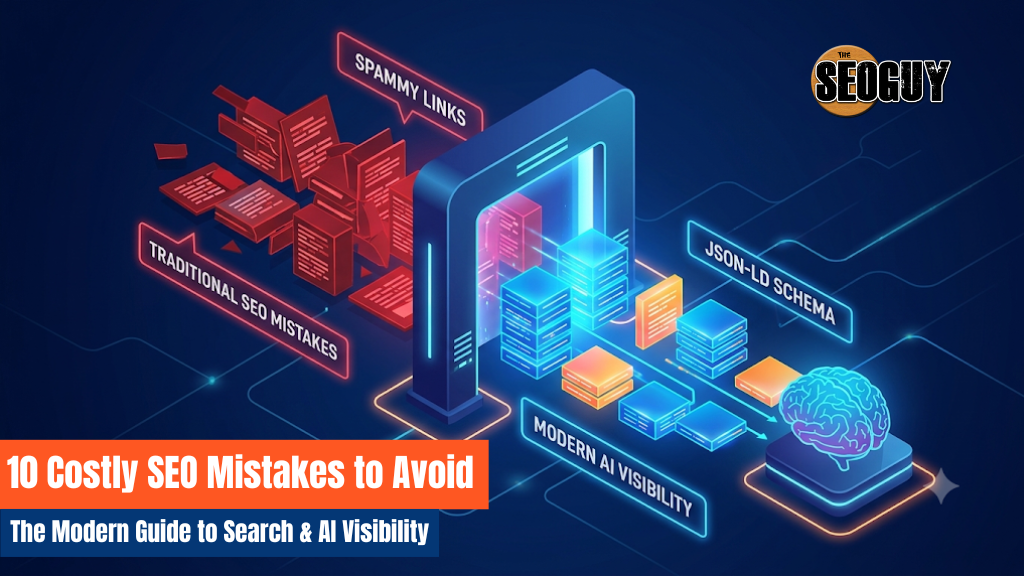
In modern search, avoiding bad SEO practices is just as critical as executing good ones. Traditional pitfalls—like keyword stuffing, purchasing spammy backlink packages, or copying competitor content—now lead to search demotions and exclusion from AI answer engines. Today’s webmasters must avoid structural errors like deep nested URL paths, missing JSON-LD schema, lack of Information Gain, and unoptimized page responsiveness (INP) to maintain strong visibility across both Google SERPs and conversational LLM platforms.
At TheSEOGuy, our technical and GEO audits protect enterprise brands from algorithm penalties and traffic drops. Below are the 10 critical SEO mistakes businesses must avoid.
Traditional SEO Mistakes vs. Modern GEO Pitfalls
| SEO & GEO Error Matrix | |
| Classic Organic SEO Errors | Modern AI & GEO Errors |
| Exact-Match Keyword Stuffing Buying Bulk Backlink Packs Padded 2,000-Word Intros Generic Meta Description | Lacking Information Gain & Data Ambiguous Entity Associations Ignoring BLUF Direct Summaries Unstructured Schema Graphs |
The 10 SEO & GEO Pitfalls You Must Avoid
1. Paraphrasing Top Search Results (Lacking Information Gain)
Regurgitating information from the top 3 ranking pages without adding unique value or first-hand experience is a primary cause of low ratings.
- What to Avoid: Writing generic, superficial text that repeats common knowledge.
- The Fix: Inject proprietary agency data, original case study metrics, or direct expert quotes to prove first-hand experience (E-E-A-T).
2. Over-Optimizing Keywords & Anchor Text (Keyword Stuffing)
Excessively repeating target keywords or using 100% exact-match anchor text creates an unnatural experience.
- What to Avoid: Cramming keyword strings into headings, body copy, and internal links.
- The Fix: Focus on semantic SEO, natural language, and contextual anchor text that helps readers navigate your site.
3. Ignoring BLUF (Bottom Line Up Front) Content Formatting
AI search engines prioritize concise, direct answers over lengthy introductory fluff.
- What to Avoid: Writing multi-paragraph intros before getting to the main point.
- The Fix: Place a 2–3 sentence direct summary at the top of key sections so LLMs can summarize your answers.
4. Overlooking Structured Data & Entity Schema
Search engines rely on structured JSON-LD schema to recognize brands, authors, and services.
- What to Avoid: Publishing content without JSON-LD schema markup.
- The Fix: Implement clean
Article,Organization, andFAQPageschema graphs to clarify entity details.
5. Deeply Nested & Messy URL Architecture
Complex URL structures confuse search crawlers and waste crawl budgets.
- What to Avoid: Using long permalinks with dates, subfolders, or dynamic session IDs (e.g.,
/blog/2024/category/seo/post-123). - The Fix: Keep slugs clean, short (3–5 words), and shallow.
❌ BAD:  theseoguy.in/blog/v2/services/seo/things-to-avoid-during-seo-2026/
✅ GOOD: theseoguy.in/things-to-avoid-during-website-seo/
6. Purchasing Cheap, Spammy Backlink Packages
Buying low-quality backlink packages or using private blog networks (PBNs) violates search quality guidelines.
- What to Avoid: Buying bulk links on gig platforms or link farm sites.
- The Fix: Build genuine authority through digital PR, high-value industry research, and unlinked brand citations.
7. Neglecting Core Web Vitals (Interaction to Next Paint – INP)
Technical latency and poor site responsiveness degrade user experience and harm search rankings.
- What to Avoid: Ignoring slow script execution, heavy layout shifts, and delayed page interaction.
- The Fix: Optimize code execution and image compression to maintain fast response times across mobile devices.
8. Relying on Flat PDF Files for Critical Information
Search crawlers and AI models struggle to extract structured details from static PDFs.
- What to Avoid: Hosting menus, brochures, or service lists solely in PDF format.
- The Fix: Publish text-based HTML content enhanced with schema markup so search engines can read and index every detail.
9. Deleting Content Blindly During Traffic Drops
Deleting pages without prior analysis can erase existing link equity and topic coverage.
- What to Avoid: Removing declining URLs during algorithm updates.
- The Fix: Restructure existing assets by adding BLUF summaries, updating factual data, and adding schema markup.
10. Failing to Audit AI Engine Presence & Brand Sentiment
Tracking traditional keyword rankings alone creates a false sense of security while users migrate toward conversational search tools.
- What to Avoid: Measuring SEO success solely through standard rank-tracking lists.
- The Fix: Audit your brand’s presence, citation share, and sentiment inside AI platforms like Google AI Overviews, Perplexity, and ChatGPT.
SEO Mistake Prevention Checklist
| Area | What to Avoid | Correct Execution | Impact |
|---|---|---|---|
| Content | Repetitive text & generic lists. | Proprietary data & BLUF summaries. | High (Boosts E-E-A-T & AI Citations) |
| Technical | Slow INP & dynamic duplicate URLs. | Clean canonicals & sub-2s load speeds. | High (Protects Crawl Budget) |
| Schema | Unstructured plain text. | JSON-LD Article & FAQPage graphs. | Very High (Enables Knowledge Graph) |
| Link Building | Buying cheap backlink packages. | Digital PR & verified brand mentions. | Critical (Prevents Manual Penalties) |
Frequently Asked Questions (FAQs)
Will using AI to generate blog content hurt my SEO?
Generative AI tools are not inherently penalized, but content created at scale with low effort, low originality, or little added value receives the lowest quality ratings. To rank well, AI-assisted drafts must be reviewed by subject experts to incorporate original data, experience, and clear BLUF summaries.
What is the most dangerous technical SEO mistake a website can make?
Blocking critical site assets in robots.txt, creating dynamic URL parameter loops, or failing canonicalization rules can prevent search engines from indexing core pages altogether.
How do I know if my website has been penalized by Google?
A sudden, dramatic drop in organic impressions and traffic across multiple pages in Google Search Console often signals an algorithmic demotion or manual action. Auditing technical health, link profiles, and content quality helps pinpoint the issue.
Protect Your Site from Costly SEO & AI Visibility Mistakes
Avoiding strategic mistakes is essential for maintaining organic traffic and building long-term search authority.
At TheSEOGuy, we conduct technical, entity, and GEO audits to help businesses fix site issues, avoid algorithm penalties, and secure citations across search engines.
👉 Contact TheSEOGuy Today to Request a Complete Technical & GEO Audit and safeguard your digital presence!
Discover more from TheSEOGuy
Subscribe to get the latest posts sent to your email.


Content, Links and quality are the main factors to decide website seo score and rankings. If the content is unique and keywords placement goes well, website ranks top among competitors.
HI Laura,
Thank you so much for the feedback.I always try to put the best information which can provide you best SEO Answers
Regards,
Ravi Kumar Rana