Why Is My Business Not Appearing in ChatGPT?
Search algorithm and search platforms are changing and adapting the artificial intelligence rapidly. Being a business owner, everyone wants to appear in different LLM platforms such as ChatGPT, Perplexity, Google Gemini and Google AI overviews. Searching your own business in ChatGPT is common and often business owners ask questions like “Why is my business not showing up in ChaGPT” but my competitors are appearing.
Welcome back to TheSEOGuy, your trusted source of search engine optimization information and tips. Today we are going to answer a commonly asked question by business owners which is “Why is my business not appearing in ChatGPT”.
It is incredibly frustrating. You’ve put years into your digital presence, you rank cleanly on traditional Search Engine Result Pages (SERPs), and you follow standard optimization rules. Yet, to the world’s most famous AI assistant, you are completely invisible.
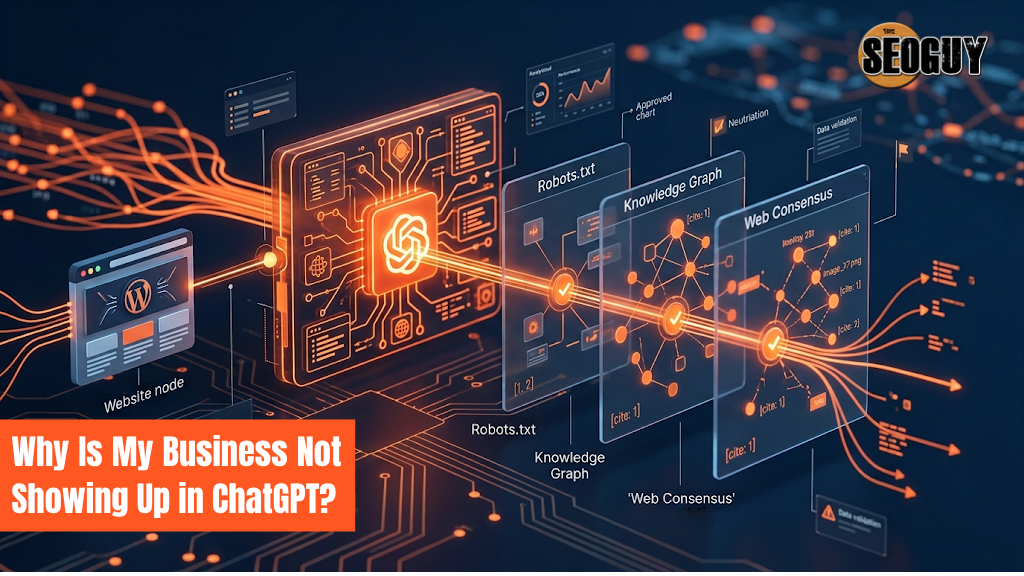
To solve this problem, you have to understand the generative AI engines are different from traditional search engines. Work mechanism, policies and algorithms are different from each other. Traditional search engines use automated systems to rank pages based on signals like keywords and indexing tags. However, ChatGPT looks the content in a different way. It reviews the digital consensus, deep semantic data structure and authoritative third-party citations. To appear in ChatGPT search results, you have to optimize for Generative Engine Optimization.
Here is the exact technical breakdown of why ChatGPT is ignoring your business and how you can change its mind.
The Technical Diagnostic Checklist: Why AI Engines Bypass Your Website
To get an automated system to trust your brand, you have to understand the rigorous guidelines that govern modern data indexing. When AI models crawl the web or synthesize real-time data, they rely on strict rules of quality evaluation, entity recognition, and information architecture.
If your website drops the ball on any of the following four areas, AI crawlers will automatically filter you out.
Your Robots.txt File is Actively Blocking AI User Agents
Traditional SEO focus relies on welcoming Googlebot. However, OpenAI uses entirely distinct user agents—specifically GPTBot and OAI-SearchBot—to crawl and browse live web content.
- The Issue: Many standard firewalls such as imunify360, security plugins i.e. cloudfare protection, or outdated robots.txt templates are set to block unrecognized bots by default.
- The Consequence: If your root directory denies entry to OpenAI’s crawlers, the AI cannot pull your live pages to supplement its responses via Retrieval-Augmented Generation (RAG).
You Have Zero Footprint in Foundational Knowledge Graphs
Whenever users ask complex questions, AI models rely on foundational database of real work people, place and things. After reviewing the data, they form answer to broad user queries. It is quite similar to knowledge graph in which google leverages hundreds of billions of verified facts.
- The Issue: ChatGPT uses highly authoritative, open-source repositories to cross-reference entities and ensure factuality.
- The Consequence: If your business lacks an active, verified node on platforms like Wikidata, Crunchbase, Bing Places, or Wikipedia, the AI lacks the core semantic anchor required to validate that your business is real.
Your Website Lacks Satisfying ‘Main Content’ and Clear Schema Architecture
As per the Google Search Quality Evaluator Guidelines, web content is systematically broken down into Main Content (MC), Supplementary Content (SC), and Advertisements (Ads). To rank at the top, a page must have satisfied, high-quality Main Content created with clear human effort, accuracy, and original insight.
- The Issue: If your site relies on low-effort, templated text or lacks JSON-LD structured data (like LocalBusiness or Organization Schema markup), AI scrapers cannot instantly parse who you are.
- The Consequence: AI engines will not spend computational power trying to “guess” your business details. If your data isn’t cleanly structured for automated systems, it is treated as low-quality or low-value filler text.
There is No Web-Wide Digital Consensus Supporting Your Brand
AI search engines are heavily guarded by automated safety filters designed to prevent “hallucinations” or the promotion of deceptive, untrustworthy services. Every AI search engine assess the quality of information based on the framework of Experience, Expertise, Authoritativeness, and Trust (E-E-A-T)
- The Issue: ChatGPT doesn’t just read your website; it checks your reputation by analyzing what independent, third-party sources say about you.
- The Consequence: If your business is completely missing from local listicles, industry roundups, forum discussions (like Reddit, Linkedin or Quora), and high-authority news mentions, the AI sees a complete lack of digital consensus. Without external verification, the system marks your entity as unverified and chooses a competitor with stronger web-wide authority.
The Step-by-Step GEO Action Plan to appear in ChatGPT search results
Let’s follow five simple steps to appear in ChatGPT search results. You don’t need massive technology to transform your digital presence from traditional search to generative engine optimization. You need to focus on optimizing for a reasoning model that demands structural clarity, factual accuracy and verified public trust.
Implement given below five-step technical roadmap to unlock your business’s visibility in generative AI overviews and conversational responses.
Step 1: Unblock and Configure AI Crawlers in Your Robots.txt
Before you can optimize your content, you must ensure that AI engines are physically permitted to read it. You need to grant access to the primary user-agents responsible for indexing conversational search data.
Access your site’s root directory and update your robots.txt file to include the following directives:
# Allow OpenAI Crawlers
User-agent: GPTBot
Allow: /

User-agent: OAI-SearchBot
Allow: /

User-agent: ChatGPT-User
Allow: /

# Allow Perplexity AI
User-agent: PerplexityBot
Allow: /

# Allow Anthropic AI
User-agent: ClaudeBot
Allow: /
Note: Use code with caution.
- Why this matters: GPTBot handles general model training data, while OAI-SearchBot powers real-time web browsing within chat interfaces. Ensuring these are unblocked allows the AI to fetch your most up-to-date business details instantly.
Step 2: Inject Advanced JSON-LD Schema to Build Machine Readability
Utilize the power of structured data because most of the Large Language Models (LLMs) understand and use structured, predictable data. By implementing the right schema markup, you help AI search engines to pass useful business information in a clean semantic layout that AI systems can parse in milliseconds.
Implement LocalBusiness or Organization Schema via JSON-LD on your homepage. Ensure it clearly defines:
- Your exact legal entity name and alternate branding names.
- Your physical coordinates, localized phone numbers, and operational hours.
- Explicit sameAs attributes linking directly to your verified social profiles, Wikidata nodes, and high-authority business directories.
Step 3: Architect High-Effort, Intent-Matching Main Content (MC)
AI search quality tests closely mirror the core principles of Google’s Quality Rater Guidelines. Automated selection systems are explicitly engineered to reward content that showcases clear human effort, originality, and depth.
To optimize your text for AI synthesis:
- Adopt a Natural Q&A Structure: Use the headings around the exact conversational topic which users type into ChatGPT or other LLMs for example; use <h2>How Startups can appear in ChatGPT?</h2>
- Lead with Direct Answers: Answer engine optimization is based on answer first approach. Focus on writing punchy, 2-3 sentence summaries at the top of your core service sections. This high-density informational format makes it incredibly easy for an AI to quote your page directly in an overview.
- Eliminate Low-Value Filler: Do not repeat the text in content. AI models grab only the crisp of content to form a quick summary or answers while ignoring fluff Make sure every paragraph delivers unique, testable facts about your industry and authority.
Step 4: Build a Node in Trusted, Open-Source Knowledge Bases

When an AI engine encounters a brand name, it attempts to cross-reference that name against a verified global index of real-world entities. If you do not exist in foundational knowledge repositories, you essentially do not exist to the model.
- Action: Claim and build out detailed profiles on public, highly-cited platforms like Wikidata, Crunchbase, and major industry-specific databases.
- The Strategy: Fill out every attribute completely—from founding dates to executive names. These platforms act as seed data for LLM training runs, forming the structural anchor that allows the AI to recognize your business as a verified, legitimate entity.
Step 5: Engineer Digital Consensus via Third-Party Citations
AI search engines and LLM platform like ChatGPT requires a web wide digital footprint showcasing your experience, expertise, authoritativeness and trust to list your business in search results. Rather than mentioning your business details solely on your own business website, focus on other external trust factors.
- Earn Mentions in Authority Lists: Spent time and efforts in running strategic PR campaigns to get your brand featured in independent marketplace listicles and editorial roundups.
- Foster Organic Discussion: Ask your clients to share their genuine experiences on active community platforms, specialized review spaces such as truspilot, and contextually relevant forums i.e. Good Firms.
- Why it works: When ChatGPT crawls the web to answer a user prompt like “Who are the top-rated B2B fintech marketing consultants near me?”, it synthesizes multiple third-party mentions. If your brand consistently appears across these independent nodes, the AI establishes a digital consensus and confidently returns your business in its response.
Conclusion: Winning the Future of AI Search
The digital landscape is undergoing a massive architectural shift. Traditional search engines that simply direct users to a list of blue links are sharing the stage with sophisticated, reasoning AI models that synthesize answers on the fly.
If your business isn’t showing up in ChatGPT or Google’s AI Overviews, it isn’t an overnight accident—it is a clear sign that your digital footprint lacks the structural clarity and web-wide consensus that automated systems require. Waiting for the next model update won’t solve the problem. To remain relevant, brands must actively transition from basic keyword targeting to true Generative Engine Optimization (GEO). By unblocking AI crawlers, implementing robust technical data structures, and aggressively building third-party authority, you can ensure that when an LLM looks for a trusted industry leader, it finds you.
Claim Your AI Search Visibility Today
Is your brand completely invisible to conversational AI? Don’t let your competitors capture the future of search traffic.
At TheSEOGuy, we bridge the gap between traditional SEO and advanced AI SEO solutions. We don’t believe in generic, rigid packages; instead, we offer completely customized, budget-friendly digital growth strategies explicitly designed to skyrocket your search engine and generative engine visibility.
Let us handle the technical heavy lifting. Schedule a Free Consultation or WhatsApp Us today to claim your comprehensive Free AI SEO Audit. We will analyze your site’s architecture, audit your robots.txt directives, and build a definitive roadmap to put your business at the top of AI search results.
Frequently Asked Questions (FAQs) – ChatGPT Visibility
How long does it take for ChatGPT to recognize new citations and business updates?
Because ChatGPT relies on a hybrid architecture of static training data and live web browsing (via Retrieval-Augmented Generation, or RAG), the timeline varies. Real-time browsing features can pick up freshly indexed, unblocked web content within 3 to 6 months if the information architecture is perfectly clean. However, deep core entity recognition typically requires the model to undergo a major foundational training update or a fresh data refresh cycle.
Why is ChatGPT citing my competitors in listicles but completely ignoring my brand?
This is usually caused by a lack of digital consensus. LLM models are specifically trained to avoid hallucinating recommendations, so they heavily rely on third-party verification to establish Trust. If your competitors are consistently mentioned in high-authority industry roundups, local directories, independent reviews, or community forum discussions, the AI views that multi-source alignment as an authoritative fact and rewards them with the citation.
Can traditional schema markup help with AI engine indexing, or do I need something specific?
Standard schema markup—specifically JSON-LD structures like Organization, LocalBusiness, or Product schema—is highly effective for LLMs. While originally designed for traditional search engines, these structured data blocks serve information in an incredibly predictable, machine-readable format. Adding explicit sameAs URLs within your schema to link directly to your verified profiles on platforms like Wikidata or Crunchbase makes it vastly easier for an AI user-agent to instantly map and cite your brand.
Does changing my privacy settings on Google affect how ChatGPT browses my business?
No. Your personal Google Account data or search history settings are entirely private, secure, and ring-fenced from external corporate systems. ChatGPT’s ability to see your business relies purely on your public website’s technical infrastructure and web-wide public directory citations. Ensuring that your site’s robots.txt file is configured to openly allow agents like GPTBot and OAI-SearchBot is what dictates AI access, completely independent of Google’s ecosystem.
Discover more from TheSEOGuy
Subscribe to get the latest posts sent to your email.