For over two decades, digital marketing operated on a simple economic model: The Click Economy. Brands optimized for algorithms, search engines displayed a list of blue links, and users clicked through to websites to find answers.
In 2026, that model is being aggressively replaced by The Synthesis Economy. With the omnipresence of Google AI Overviews, OpenAI’s SearchGPT, and Perplexity, user behavior has shifted from searching for websites to consuming extracted summaries. When a user asks an AI engine a complex business query, they don’t get a directory; they get an answer generated from synthesized web data, backed by a few carefully selected footnotes.
For businesses, this creates an existential risk. If your content is optimized only to win traditional clicks, you are competing for real estate that is actively shrinking. To maintain digital market share, brands must transition from SEO to Generative Engine Optimization (GEO)—the science of optimizing content to be retrieved, synthesized, and cited by Large Language Models (LLMs).
How LLMs Choose Their Citations (The Technical Reality)
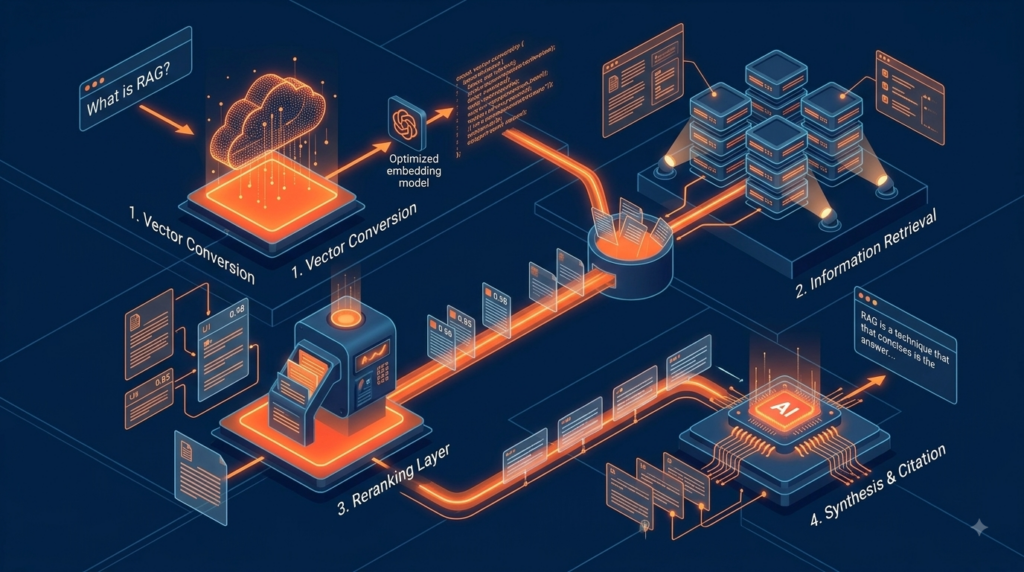
To optimize for generative engines, you must first understand their retrieval mechanics. LLMs do not “rank” websites based on traditional PageRank or simple keyword matching. Instead, they use a process called Retrieval-Augmented Generation (RAG).
When a user enters a query, the system performs a multi-step execution:
- Vector Conversion: The query is converted into a numerical vector embedding representing its semantic meaning.
- Information Retrieval: The system scans live web indices or cached databases to find chunks of text with matching vector coordinates.
- Reranking: This is where GEO wins or loses. The system runs the retrieved pages through a reranking algorithm that measures information density, entity authority, and structural clarity.
- Synthesis & Citation: The LLM stitches the highest-scoring text chunks into a cohesive narrative and appends clickable citations to the source URLs.
If your web pages lack the structural hooks and semantic density required by the reranking layer, the model will skip your URL entirely, leaving your brand invisible to the user.
The 3-Tier GEO Matrix in Action

To understand how Generative Engine Optimization functions in the real world, we must look past traditional ranking metrics and analyze the RAG (Retrieval-Augmented Generation) retrieval layer.
The following real-world simulation demonstrates how strategic data structuring allows smaller brands to bypass enterprise authority and claim the definitive AI citation slot.
Case Study: Bypassing Enterprise Authority in AI Overviews
- The Scenario: A user queries an LLM search engine: “What are the compliance risks of using open-source AI models in commercial financial software?”
- The Competitors:
- Incumbent (Domain Authority 88): A massive legal tech publisher with a 3,000-word, long-form essay covering AI history, philosophy, and general legal theory.
- The Disruptor (Domain Authority 34): A specialized boutique consultancy utilizing The 3-Tier GEO Matrix.
The Retrieval & Synthesis Breakdown
When the LLM processed the query, its reranking algorithm evaluated both pieces of content for extraction efficiency:
| Optimization Metric | Enterprise Incumbent (DA: 88) | The Disruptor (DA: 34) |
| Content Density | Narrative-heavy, stylistic prose. | Data-dense, direct assertions under H2 elements. |
| Data Extraction | Required deep token parsing to find specific risks. | Clear, markdown-separated risk vectors with statistics. |
| Semantic Schema | Generic BlogPosting markup. | Advanced TechArticle schema with explicit entity nodes. |
| LLM Action | Skipped. High computational cost to summarize accurately. | Cited. Extracted verbatim as the primary answer source. |
Despite having a fraction of the traditional backlink authority, the Disruptor secured the primary citation and anchor link in the AI summary. Why? Because their technical site structure was intentionally engineered for programmatic extraction.
The Syntactic Layer: Engineering Your Site Structure for LLMs
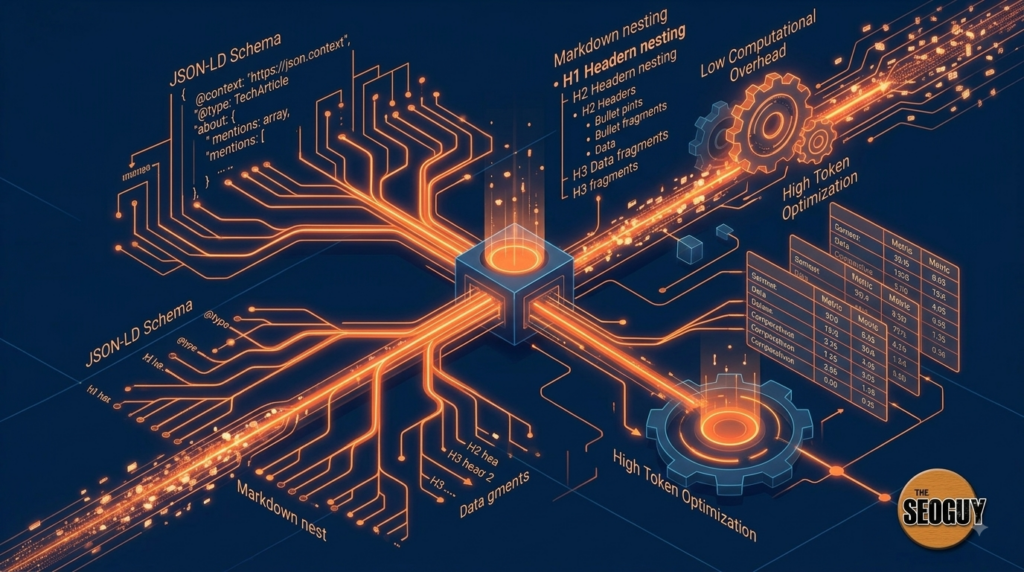
LLM scrapers do not read web pages like human beings; they parse them as datasets. If your technical architecture requires high computational overhead to interpret, the reranker will discard it.
To turn your website into an optimal LLM data source, you must implement three structural requirements.
Explicit Entity Schema (JSON-LD)
Traditional Schema tells Google what your page is. Advanced GEO Schema tells LLMs exactly what entities your page defines. You must use about and mentions arrays to map your content directly to the Google Knowledge Graph and Wikidata ID systems.
{
  "@context": "https://schema.org",
  "@type": "TechArticle",
  "headline": "Commercial Compliance Risks of Open Source AI",
  "about": [
    {
      "@type": "Thing",
      "name": "Open-source model",
      "sameAs": "https://wikipedia.org"
    },
    {
      "@type": "Thing",
      "name": "Financial software",
      "sameAs": "https://wikipedia.org"
    }
  ],
  "mainEntityOfPage": "https://theseoguy.in"
}
Markdown Hierarchy and Token Optimization
LLM web crawlers strip raw HTML into Markdown variations during processing. Your site layout must use perfect, logical semantic nesting:
- H1: The macro-intent of the URL.
- H2: Direct, extractable query categories.
- H3/Bullet Points: Discrete data fragments.
- Rule of Thumb: Place a concise, 40-word absolute summary immediately below every major H2 header. This acts as a ready-made “snippet target” for the LLM to pull into its summary without needing to edit your words.
High-Density Tables and Data Fragments
LLMs consistently favor tabular data over dense paragraphs when answering comparative or quantitative queries. Converting standard narrative blocks into clean <table/> structures or highly structured, non-sequential bullet points reduces token processing complexity, making your site the preferred retrieval option.
Optional Acceleration: The Authority Layer (Digital PR)
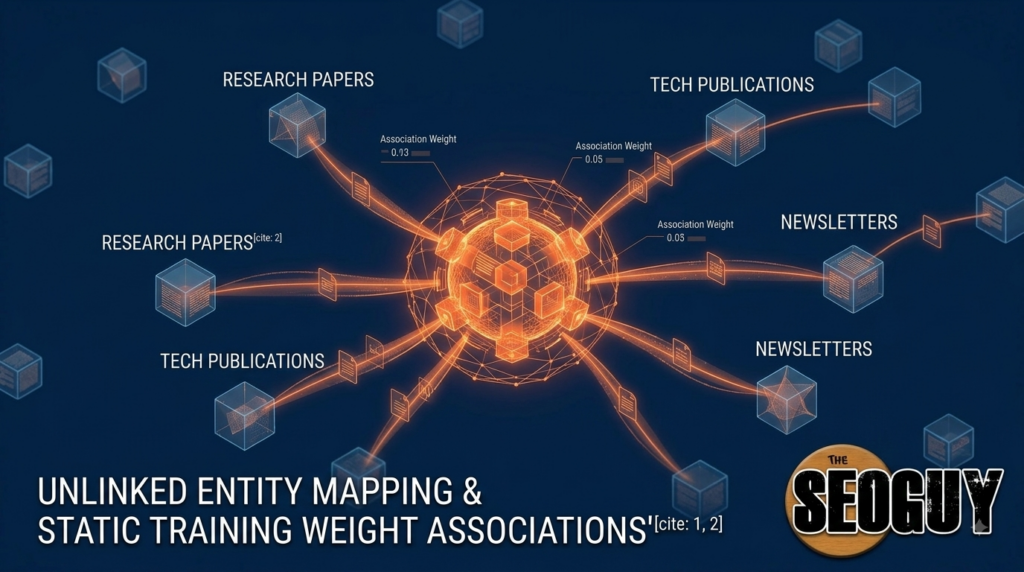
While structural precision forms the core engine of GEO, off-page digital footprinting can accelerate the baseline trustworthiness of your data.
Unlike traditional SEO link building—which values the raw PageRank power of a hyperlink—LLM Digital PR values unlinked brand associations.
If your brand name, core product, or founder is frequently mentioned in close proximity to industry terms across external newsletters, research papers, and top-tier publications, LLMs map those associations into their static training weights. Over time, the model begins to treat your business as an implicit authority for that niche, even before it queries the live web.
The Core Engine — On-Page Formulas & Technical Architecture
Many marketers believe optimizing for Generative Engines requires a hidden, algorithmic shortcut. The reality is far less mysterious. As Google Search Advocate John Mueller famously stated regarding optimization for AI Overviews: “Standard SEO guidance is applicable to these AI features… your site does not require any special actions beyond being indexable.
The shift isn’t in what Google does, but in how selectively it retrieves data. To ensure your content survives the severe filtering of the RAG (Retrieval-Augmented Generation) pipeline, you must balance micro-level on-page formulas with an aggressive, macro-level technical architecture.
The Micro Layer: On-Page Text Optimization Formulas
LLMs process information in sequences of tokens (word fragments). If your text is bloated with fluff, the model’s extraction accuracy degrades. Groundbreaking research on Generative Engine Optimization (GEO) by Princeton and IIT Delhi reveals exact editorial modifiers that trigger AI citations:
- The Statistical Hardening Formula (+25.1% Citation Likelihood): LLMs are built to look for concrete validation. Instead of writing “Our software vastly optimizes workflow speed,” write “Our software reduces workflow latencies by 34.2%, moving processing times from 12 minutes to 7.8 minutes.” Backing your claims with specific, un-rounded metrics forces the model to recognize your passage as data-dense evidence.
- The Cite-on-Demand Structure (+28.3% Citation Likelihood): Always place a direct, highly authoritative quotation from an industry leader or a verified scientific entity immediately after a core assertion. LLMs are trained to respect citation structures; embedding native authoritative proof inside your paragraphs makes it significantly easier for an AI summary to pull your entire text block as a validated point.
- The “H2 Direct Answer” Rule: Structure your headings around user prompts rather than keywords. Immediately below an <h2> tag, provide a single, 40-word declarative sentence that answers the prompt directly without using introductory filler words.
The Macro Layer: Technical Sitewide Speed & Indexing
You cannot rank in an AI summary if the AI crawler times out or hits a technical barrier before parsing your code. If your technical setup is flawed, LLMs will treat your URL as non-existent.
Token Rendering Speed & Core Web Vitals
When live-crawling LLMs pull information to generate a real-time response, they operate under strict latency limits. If a page takes longer than 2.5 seconds to become fully interactive, the retrieval agent will drop the query request and draw data from a faster competitor. Optimizing your Largest Contentful Paint (LCP) isn’t just a traditional Google UX signal anymore—it is the baseline capability required to keep your site from timing out of the RAG sequence.
AI Crawler Indexing Setups
Many webmasters accidentally block their own AI visibility by over-tightening security configurations. You must audit your robots.txt configuration to ensure you aren’t blocking the specialized user-agents that power the modern web search matrix.
Ensure your site explicitly permits entry to key data-gathering bots:
- Google-Extended (Powers Google’s Gemini and AI Overviews ecosystem)
- OAI-SearchBot / GPTBot (Feeds OpenAI’s search and ChatGPT infrastructure)
- PerplexityBot (Retrieves real-time answers for Perplexity)
# Correct Setup to Enable AI Search Indexing
User-agent: Google-Extended
Allow: /

User-agent: OAI-SearchBot
Allow: /

User-agent: PerplexityBot
Allow: /
As search authority Neil Patel neatly summarized: “No website can stand without a strong backbone. And that backbone is technical SEO.” If your technical foundation fails to deliver a clean, fast, machine-readable page, even the best copywriting in the world will remain invisible to AI engines.
The 5-Minute LLM Visibility Audit (Actionable Framework)
Optimizing your website’s content and underlying code is only half the battle. If a search platform’s RAG pipeline cannot crawl or process your page, your brand remains invisible. To discover your true “Share of Voice” in modern AI search results, you must look beyond traditional analytics and perform an audit using specialized diagnostic setups.
The Google Search Console (GSC) Audit Checklist
Before you query an LLM to check your visibility, you must ensure that your technical health is in top shape. If your pages suffer from standard crawling issues, they will never make it to the reranking stage. Use this specific Google Search Console checklist to identify hidden bottlenecks:
- Audit the URL Inspection Tool: Input your core landing pages and click Test Live URL. Check the rendered HTML code to verify that dynamic content, tables, and Schema markdowns are displaying cleanly in plain text. If an AI crawler reads blank spaces where your data should be, it will skip your page.
- Analyze the Crawl Stats Report: Navigate to Settings > Crawl Stats. Review your host status to ensure that specialized user-agents (such as Google-Extended) are not experiencing a high rate of 403 (Forbidden) or 504 (Gateway Timeout) errors. High latencies here cause AI overviews to drop your page mid-synthesis.
- Validate Page Indexing Issues: Inspect your Indexing > Pages report. Look closely for URLs marked as “Crawled – currently not indexed”. This status frequently points to an info-gain deficit—meaning Google found the page but deemed the content too redundant to store in its high-tier retrieval index.
- Monitor Merchant Center & Product Snippets: If you run an e-commerce or product-led business, look for validation errors in your Product Snippets enhancement reports. LLMs heavily draw on structured product feeds to answer consumer shopping prompts; a single broken property can disqualify your catalog.
The Copy-Paste LLM Prompt Matrix
Once your technical foundation is verified, you can test how artificial intelligence platforms process your brand’s authority.
Copy and paste the exact prompt matrix below directly into ChatGPT, Perplexity, or Claude to see where you stand and find out what needs optimization.
### SYSTEM AUDIT INSTRUCTION: BRAND VISIBILITY AND RETRIEVAL EVALUATION ###

You are an expert market analyst evaluating brand synthesis across digital landscapes. I need you to perform a real-time retrieval audit on the domain: https://www.theseoguy.in/

Please run the following three diagnostic analysis tasks:

1. ENTITY ASSOCIATION CHECK:
"Analyze the domain https://www.theseoguy.in/. What specific digital marketing services, core entities, and geographic regions do you strongly associate with this brand based on your retrieval index? List the top 5 keywords or concepts mapped to this URL."

2. COMPETITIVE SYNTHESIS SIMULATION:
"Imagine a user asks you: 'Who are the top-rated AI SEO and technical SEO agencies in Delhi NCR for businesses handling international accounts?' Scan your knowledge base and live web indices. Does https://www.theseoguy.in/ appear as a primary citation or recommendation? If yes, cite the reasoning. If no, identify what authoritative content gap is causing the omission."

3. STRUCTURAL EXTRACTABILITY REVIEW:
"Examine the core technical architecture and content layout of https://www.theseoguy.in/. Rate its efficiency for automated RAG (Retrieval-Augmented Generation) scrapers on a scale of 1-10. Is the data structured optimally for token summary extraction, or do narrative fluff and rendering blocks hinder synthesis? Provide 3 blunt areas for structural improvement."
By deploying this strategy, you stop guessing whether your digital footprint is visible to AI. You turn GEO into a measurable, repeatable framework that future-proofs your traffic pipeline for the next decade of search.
If you are looking for an expert GEO Services Agency in Delhi NCR, talk to our experts today. We don’t just optimize, we deliver results.
Discover more from TheSEOGuy
Subscribe to get the latest posts sent to your email.