For over twenty years, eCommerce search engine optimization followed a simple rule: optimize for the search grid. If you ranked in the top three organic results for a valuable keyword, you secured a steady stream of traffic and conversions.
That era is over. The “Click Economy” is rapidly shifting toward a Zero-Click Economy.
Today, millions of shoppers skip traditional search engines entirely. Instead, they use platforms like ChatGPT Search and Perplexity Shopping to do their heavy lifting. When a user asks an AI tool to “Find the best lightweight running shoes for flat feet under $150,” they aren’t met with a page of blue links.
They get a highly tailored, interactive AI Shopping Carousel complete with side-by-side product cards, specifications, and instant buy buttons.
If your store’s products aren’t being dynamically pulled into these AI carousels, you are completely invisible to a demographic that spends 57% more per order than traditional shoppers. To stay ahead, you need to pivot from traditional SEO to Generative Engine Optimisation (GEO). This guide details the exact technical framework required to force ChatGPT and Perplexity to recommend your products.
How AI Shopping Assistants Filter Products

Traditional search engines rely heavily on keyword densities and backlink profiles. AI models operate as conversational matching systems. When evaluating items to display in a shopping carousel, they grade websites on a different set of strict parameters:
- Structured Attribute Accuracy: AI engines rarely guess. They parse hard product data—like dimensions, materials, and exact prices—from structured files.
- Intent-Match & Utility: LLMs assess whether a product description directly answers a user’s situational constraint (e.g., “good for lower back pain” or “weatherproof for cyclists”).
- Sentiment Profiles: Before recommending a product, AI engines crawl third-party review platforms, forums, and Reddit threads to verify if human consensus matches your promotional text.
Maximize On-Page Feed and Schema Discipline

If your data isn’t structured for easy extraction, AI platforms will bypass your site entirely. You need to treat your product pages like data feeds.
- The Schema Baseline: Between 65% and 71% of AI-cited web pages use deep structured data. You must go beyond basic price and availability schema.
- The Solution: Leverage JSON-LD Schema to nest deeply specific attributes using
additionalPropertyblocks. This provides explicit data points for the AI engine to drop straight into comparison tables.
Write “Answer-First” Product Descriptions
Many eCommerce brands fill their product pages with creative, poetic copy designed purely for human emotion. While branding matters, it fails when processed by AI scrapers. AI platforms need plain-language, high-density facts.
- The Bad Approach: “We are completely obsessed with this daypack—it’s our absolute go-to for crushing the daily grind in flawless style.” (Zero informational value for an LLM).
- The GEO-Optimized Approach: “This lightweight 18L daypack is engineered for urban commuters and cyclists who require weatherproof storage. Features a 15-inch laptop compartment and weighs only 0.8kg.”.
Action Item: Prioritize data clarity in the first two sentences of every product description. State exactly what the product is, who it is for, and the precise problem it solves.
Integrate with Ecosystem Native Channels
Getting listed organically is only half the battle. To unlock premium real estate within carousels, you need to integrate with native programs:
Optimize Your Shopify Catalog for ChatGPT
If you run on Shopify, your catalog can be made discoverable inside ChatGPT via Agentic Storefronts. Ensure your direct checkout options are properly configured in your Sales Channels settings so users can transition seamlessly from discovery to purchase.
Enroll in the Perplexity Merchant Program
Perplexity offers a dedicated merchant ecosystem that features a zero-commission, zero-listing-fee structure.
Manage Your Off-Page “Sentiment Profile”
AI shopping assistants do not rely on your website alone. They continuously cross-reference user-generated content (UGC), expert reviews, and forum discussions to verify your product’s authority.
If your on-site copy claims a jacket is “100% waterproof,” but Reddit threads or Amazon reviews consistently mention that the zippers leak, the AI will exclude your product card from high-intent queries.
- Action Item: Focus on digital PR and review acquisition. Actively request reviews that include semantic modifiers (e.g., “lightweight”, “durable”, “true to size”). When an LLM summarizes web data, these specific adjectives trigger product inclusions.
Traditional SEO vs. eCommerce GEO
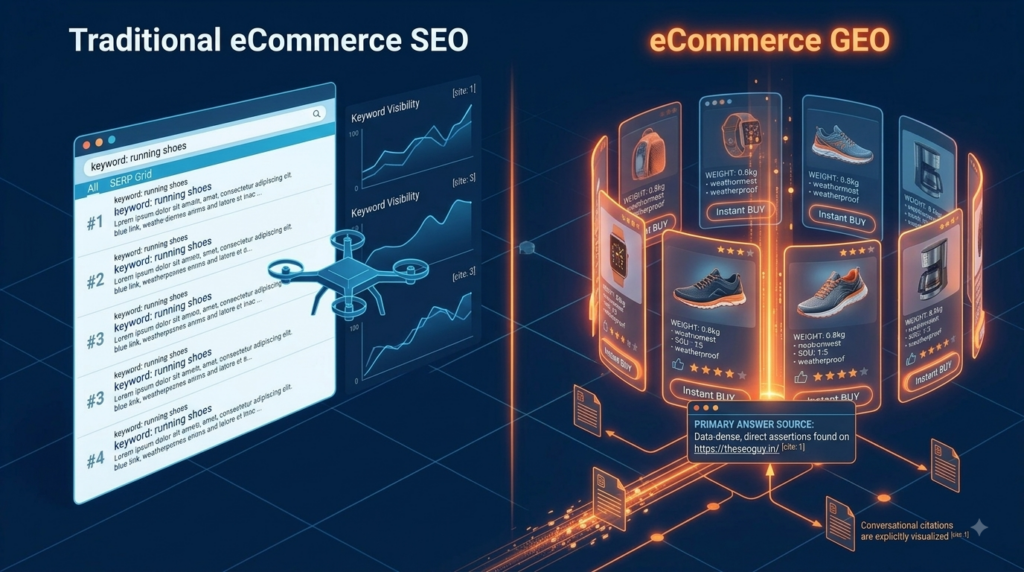
| Feature Dimension | Traditional eCommerce SEO | Generative Engine Optimisation (GEO) |
|---|---|---|
| Primary Target | Search engine bots (Googlebot) | Large Language Models (LLMs) |
| Visibility Metric | Keyword rankings & SERP positions | Conversational recommendations & citations |
| Content Priority | Headings, keyword counts, meta copy | Deep JSON-LD attributes, direct query answers |
| Conversion Focus | Driving clicks to an onsite landing page | Product card placement & in-chat checkout options |
Dominate the Future of Retail Search with TheSEOGuy
Transitioning a massive eCommerce storefront from keyword-based indexing to programmatic entity-level optimization requires precision, deep technical expertise, and an unyielding commitment to data accuracy.
At TheSEOGuy, we have been guiding national and international businesses through search engine evolutions since 2009. We specialize in transparent, affordable, and trusted SEO and GEO frameworks tailored to maximize your revenue quality. We don’t implement hidden tactics or apply risky shortcuts—just clean, data-driven strategy built to ensure your store ranks wherever shoppers are looking.
Don’t let your business become invisible in the age of artificial intelligence.
Talk to Our Experts at +91-9968182198 and Schedule Your Free AI Consultation Today. to see how we can keep your -products positioned exactly where they belong.
Discover more from TheSEOGuy
Subscribe to get the latest posts sent to your email.